Maggie’s Hammer, described by the London Daily Telegraph as “riveting” and “intriguing,” is the book that exposes the origins of a netherworld of modern geopolitical scandals, including the connections between Jeffrey Epstein, illegal arms-dealing and Mossad; Robert Maxwell, Donald Trump, Vladimir Putin and the Russian Mafia; Israel, Iran and money-laundering through the City of London; what was the power-play with Russiagate and Crossfire Hurricane; and what lay behind the assassination of Charlie Kirk.
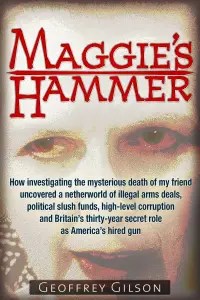
Maggie’s Hammer describes Geoffrey Gilson’s 20-year investigation into the mysterious death in November 1988 of his close friend and political mentor, Hugh Simmonds CBE, Margaret Thatcher’s favorite speechwriter, who turned up dead in a woodland glade a few miles from their sleepy suburban hometown 20 miles west of London.
Gilson’s first discoveries were that $7 million were inexplicably missing from the clients’ accounts of Simmonds’ law firm; that Simmonds was a senior officer in Britain’s MI6; and that, through his closeness with Margaret Thatcher, Simmonds had been personally tasked by Thatcher with dangerous clandestine missions.
Asking all the right questions in all the wrong places, Gilson was subsequently thrust into the dangerous world of international arms deals, covert intelligence operations and high-level political corruption, where he uncovered a secret that explains much of contemporary history and its attendant headline scandals, including Iran-Contra, WMD in Iraq, Epstein, Trump, Russiagate, and the assassination of Charlie Kirk, and involving high-profile individuals and entities from Margaret Thatcher to Tony Blair, the Russian Mafia to Mossad, and Robert and Ghislaine Maxwell.
After 20 years of high-risk adventure coupled with painstaking research and firsthand interviews, Gilson is able in Maggie’s Hammer to trace the lineage of global and covert financial and intelligence networks built in the Eighties by a team headed by Hugh Simmonds at the behest of Margaret Thatcher. These networks turned the City of London and the British Establishment into the world’s preeminent funding center for state and none-state covert operations and high-stakes criminality, from coup d’etats to mercenary armies, and including drug-running, money-laundering, and human trafficking. Understanding these networks, which have become even more powerful since the Eighties, is key to understanding what is happening around the globe right now.
As a foretaste, Maggie’s Hammer chronicles how, in the Eighties, Western intelligence agencies faced global conflicts—the Iran-Iraq War, instability in Central America, and the restructuring of global finance—that created opportunities and incentives to run off-the-books operations. These were not limited to Iran-Contra. They were part of a broader system that raised and laundered money outside official government channels to fund covert military and political efforts around the world. In the U.S., these networks are sometimes collectively referred to as “The Enterprise” or “The Octopus.” Gilson’s research shows that the operational hub for these activities was not Washington—but London.
The City of London, with its longstanding role as a permissive global finance center, became the meeting point for intelligence officers, arms dealers, defense contractors, private banks, and political party finance operations. Networks connecting elements of MI6, the Conservative Party finance apparatus, and global defense-industry intermediaries set up complex pipelines for money laundering, arms financing, and covert influence operations. Individuals such as Ari Ben-Menashe, arms-network financiers, and even later-notorious figures like Jeffrey Epstein intersected with these systems.
One of Gilson’s key findings is that these networks were not dismantled. They evolved, privatized further, and embedded themselves inside offshore finance systems—particularly in the Caribbean. Belize, in particular, became a hub linked to British political financiers and commercial elites. These structures have continued to influence political and intelligence decision-making in the UK across party lines, from Thatcher to Blair and now Starmer, while acting as facilitators and power-players to advance corruption and covert conspiracies around the world.
The corrupt networks uncovered through first-hand investigation by Geoffrey Gilson, and involving the likes of Robert Maxwell, Mossad, MI6, the CIA, and the Russian Mafia, lead all the way to current headlines and scandals, including Jeffrey Epstein, Russiagate, Crossfire Hurricane, Israel-Gaza, Ukraine, Iran, and the assassination of Charlie Kirk.
The former Israeli Intelligence officer, who was the primary source about Mossad in Geoffrey Gilson’s investigations, has confirmed that Epstein began making his fortune in London in the Eighties, engaging in the same arms-dealing and money-laundering activities as Hugh Simmonds. Vladimir Putin undertook the influence campaign known as ‘Russiagate’ (which led to the ‘Crossfire Hurricane’ investigation), in order to protect the billions of dollars in stolen assets that had been laundered out of Moscow, using the same networks that Hugh Simmonds and Robert Maxwell had established. In the weeks before his assassination. Charlie Kirk had indicated that he was intending to examine the links between Epstein and Mossad (set in place in London in the Eighties). Exposure of those links would have revealed Epstein’s involvement in arms-dealing and money-laundering for corrupt western intelligence agencies, Mossad, and the Russian Mafia.
In the words of Geoffrey Gilson: “All roads from modern global headlines and scandals lead to London in the Eighties, and the best roadmap for understanding global corruption in London in the Eighties is Maggie’s Hammer.”

